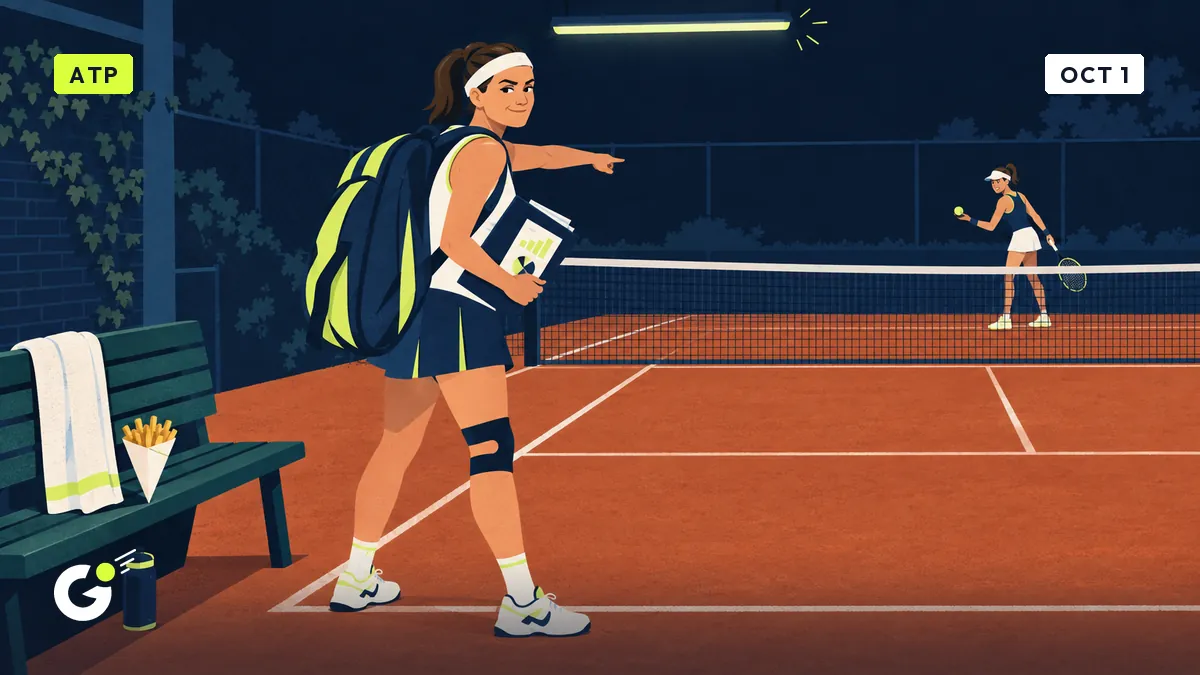

Silly question, but how can a racket be banned and allowed at the same time? That is what happened on 2 October 1977 in Aix-en-Provence, and I reread it three times in my kot (student digs) before I believed it.
The International Tennis Federation banned the spaghetti racket the day before the final. But the ban was only to take effect once the tournament was over. So for one day, the racket was banned for later. The next day, Ilie Nastase used it against Guillermo Vilas and won. End of Vilas’s run of 53 consecutive wins on clay, a record that stood untouched for nearly thirty years.
Trailing by two sets to love, Vilas walked off the court in protest at the racket, which in his view gave an unfair advantage. I see his point: he was playing against an object that had already received its redundancy letter but was still working its notice.
I looked into where this string job came from. Invented in Germany by Werner Fischer. Mike Fishbach used it to beat Stan Smith at the US Open. And at the start of the autumn clay swing in France, Nastase himself lost to Georges Goven, who was using it. Afterwards he said: “It’s the first time I’ve played against someone using this thing. It’s also the last. In future I’ll refuse to play. Goven made a fool of me. I may not be at the top of my form, but still…”
In the final in Aix, he was the one holding the thing. I wrote in my notebook: “refuse to play against” and “play with” are not the same sentence. I’m told it’s tradition, fine, but what does that mean?
It’s very simple: a rule that starts tomorrow is a rule that doesn’t exist today, you see.
Vilas had won eleven tournaments that season by the time he arrived in Aix, including Roland-Garros and Forest Hills. And it was the first time an ATP tournament had been played at the Country Club d’Aix-en-Provence. First tournament, last day for a racket. I checked, and actually nobody has explained to me why the ban couldn’t simply be brought forward by a day.
It’s true, we checked: Tennis Majors (FR).