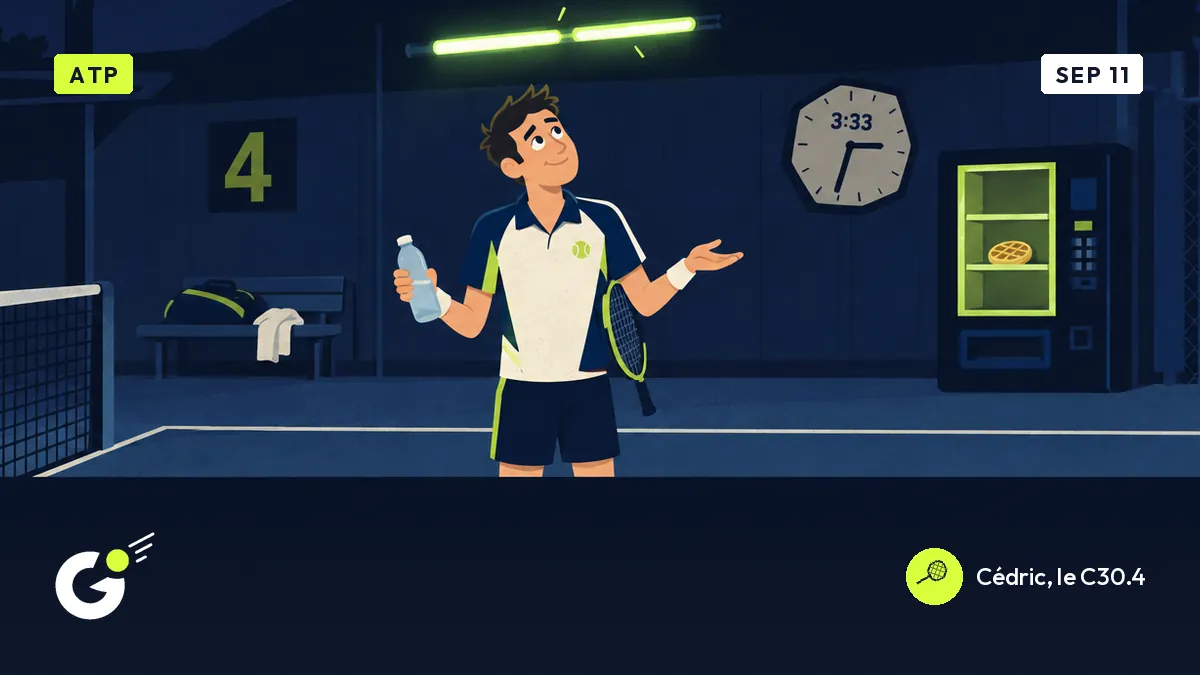
3.33am for the end of Shelton-Alcaraz at the US Open. The tournament strung together one endless night session after another, L’Équipe calls them « nocturnes à rallonge », and the question it asks is a simple one: is there any way out of this « grand bazar nocturne »?
Cédric, our C30.4 (a club-level ranking), read all of it with the calm of a man who has been there. Not in New York, obviously. Fifteen kilometres from his house, on a Sunday in May, in provincial division two.
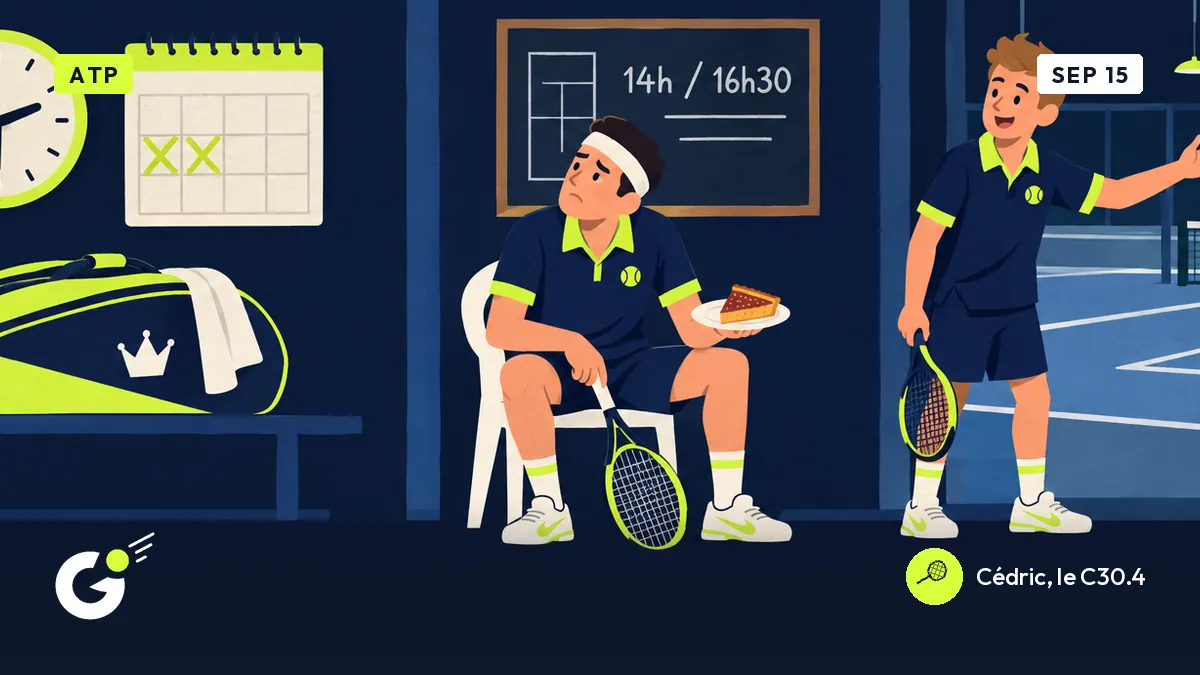
Finishing at 3.33, honestly, doesn’t shock me. Us, one time, the deciding doubles started at 22.10 because the singles had dragged on. The caretaker told us he was locking up at midnight. We finished in the dark, with the strip light on court 4 flickering once every three seconds. Alcaraz has floodlights. Two practice sessions away and with that lighting, mind you.
What interests him here isn’t the institutional debate. It’s how you manage the body afterwards. He explains that a match ending that late never really gets recovered, that the next day the intentions aren’t the same, that the patterns collapse by the third game. Strength-and-conditioning vocabulary, applied to a Monday at the office.
His other point, rather more defensible: nobody eats properly at that hour. He had a dry waffle from the club house machine and half a bottle of still water. He still brings it up.
Right, it’s very simple: the late finishes, I called them. Me, in Kitzbühel in ’92, we played very late too. Fine, there were fewer people watching, and it was the afternoon, but the spirit was there.
The debate over night-session scheduling is still open. The strip light on court 4 has never been fixed.
It’s true, we checked: L'Équipe.