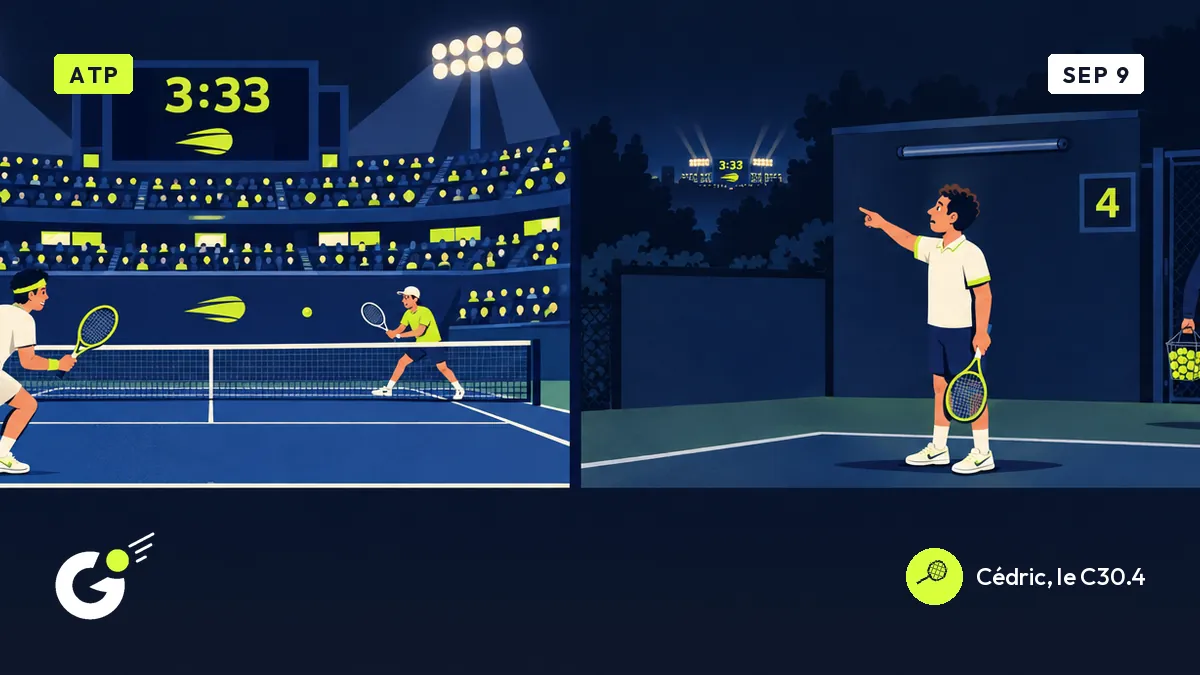
Start 11.05pm, finish 3.33am. More than four hours of play, and a record for the US Open, which has no curfew: both matches of the evening session are played out to the end.
Technically, what I look at in that kind of finish is the intentions from the baseline once the body stops following. The patterns get shorter. People think it’s physical, it’s mostly clarity of mind.
Playing at 3am, I do it. Not every time, but I do it. The problem with us is the structure: on a Sunday the club shuts, the captain puts the balls away and the bar counts the till. On court 4 under that strip light, you don’t finish a tie-break at 10.40pm, let alone a fifth set at 3.33am. Two practice sessions away, mind you. And decent lighting.
Alcaraz described the aftermath: “It’s extremely hard on your body. […] You don’t get back to your hotel until around 4.30am, the adrenaline is still going, so you can’t sleep until 6 or 7. It throws your whole rhythm off for the rest of the week.” That is a hotel room at about 4.30am and a week knocked sideways. Iga Swiatek said: “You need four hours in any case.”
The rules leave little room. If the first evening match isn’t finished by 11.15pm, the second can be moved to another court, and that’s it. The session starts at 7pm at the earliest, with two matches per stadium.
The level of a 3am finish has gone way up, people don’t realise. My season really starts in May, but give me a court lit until sunrise and I’ll revise the calendar.
The other Grand Slams moved before New York. The Australian Open went from 14 to 15 days after Murray-Kokkinakis finished at 4.05am in 2023. Roland-Garros has scheduled a single match in its night session since 2021, starting around 8.30pm. Wimbledon plays between 11am and 11pm and resumes the next day whatever isn’t finished. At the US Open, the afternoon schedules in the big stadiums were shortened this year, with no other change.
It’s true, we checked: HLN.