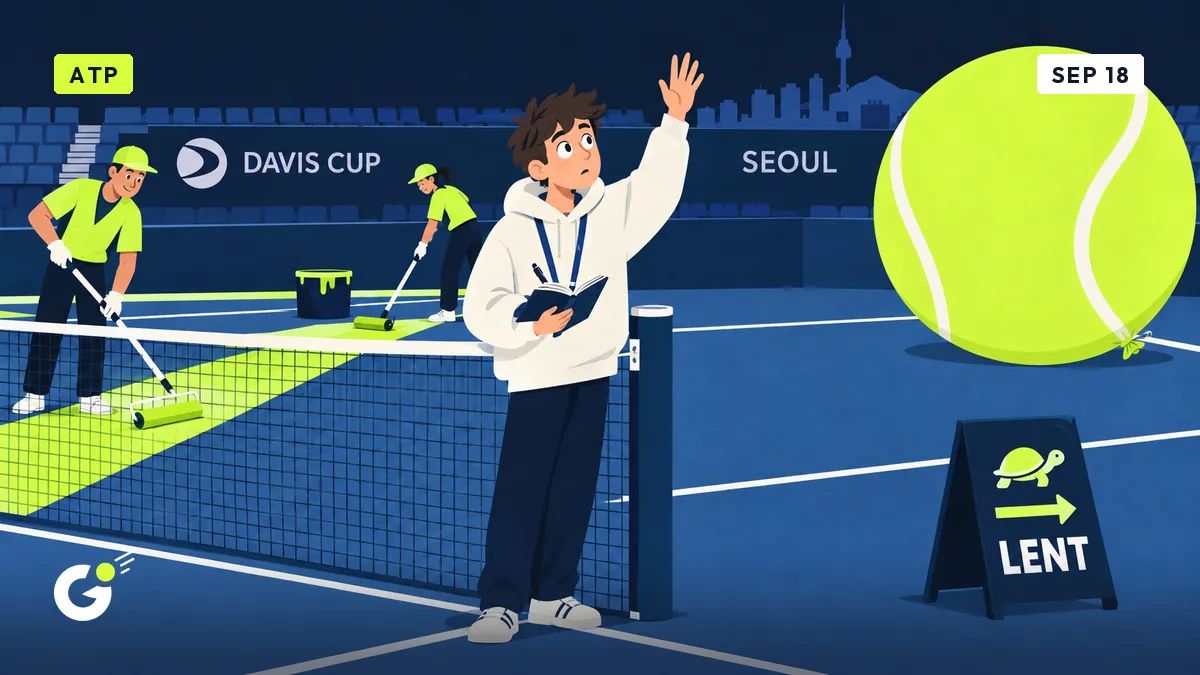

At the US Open, Alexander Zverev was penalised several times for going over the time limit on his serve. The cause: his repeated ball bouncing. Karen Khachanov, his semi-final opponent, said so. Ben Shelton, his opponent in the final, too.
Boris Becker and Andy Roddick sided with the two of them. Mark Petchey defended the world number two. Then Jimmy Connors spoke on his podcast, Advantage Connors: those habits give Zverev confidence, and it is up to his opponents to ignore them.
Connors also produced his own counter. “I was a very superstitious player too and I had to do a precise number of bounces. I bounced the ball between eight and eighteen times,” he said. He added that he always had to finish on an even number, and mentioned Venus Williams, who never stepped on the line.
Jean-Pol listened to the episode twice, “to check they’re not quoting me”.
Right, it’s very simple: ninety per cent of players count their bounces, and I’m being generous. I’ve been saying it for years, nobody listens. Careful, I’m not saying the shot clock is wrong. I’m clarifying that it starts too early, you see.
Someone points out that in March he called these rituals “childish nonsense”. He replies that the context was different, that the balls were different too, and moves straight on to Kitzbühel.
Me, in Kitzbühel, in ’92, against a future top 10: twelve bounces. Sometimes fourteen. Never thirteen, that isn’t done. That match, I win it. Well, I win it in spirit, all right?
Connors went no further than a wager: “I bet he’s working on it. I bet he’ll try to do it, if he gets the chance.” And then the caveat, which he did state plainly: superstition is still superstition. His comments were reported by Tennis World Italia.
It’s true, we checked: We Love Tennis.