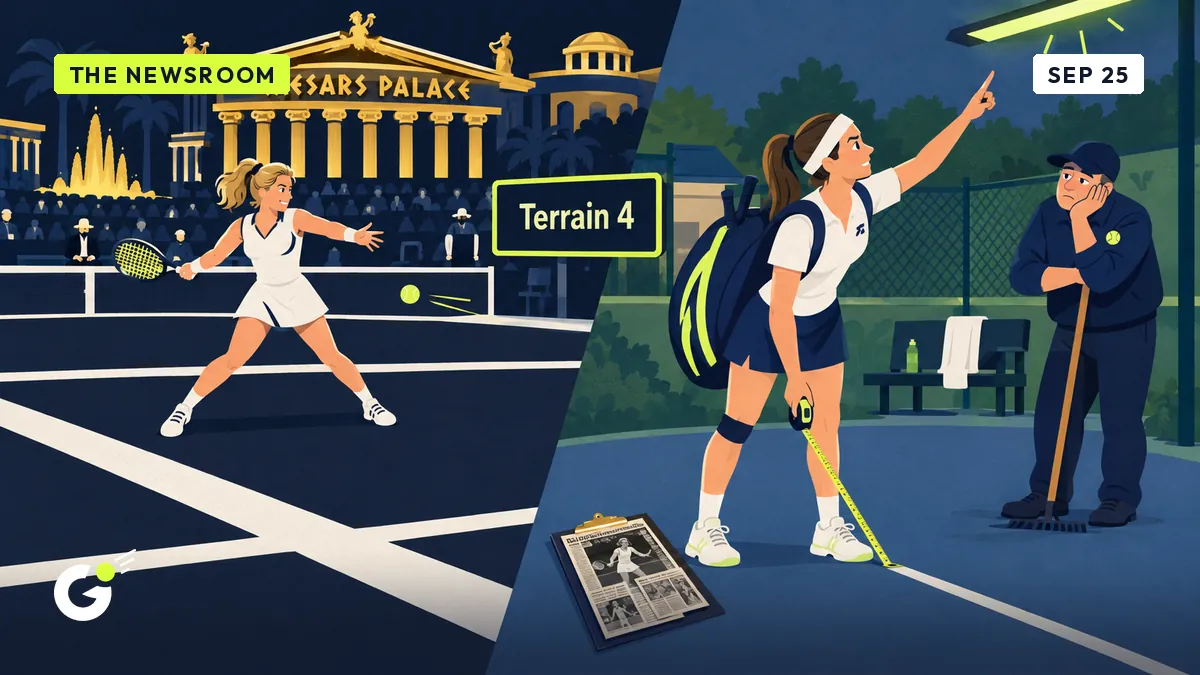
The match took place at Caesars Palace, the luxury hotel-casino that opened in 1966, as part of the “Battle of Champions”. Connors had just turned 40, Navratilova was about to turn 36. To even things out, the organisers adjusted the rules: only one serve allowed for him, the court widened by half a doubles alley on each side for her.
A court widened by half a doubles alley on each side, technically, I’ll take that too. Not to win a Caesars Palace, mind you, just for court four on Sunday, where the strip light eats up ten centimetres on the right.
Navratilova already had 18 Grand Slam singles titles by then, nine of them at Wimbledon, plus 31 doubles titles and six mixed doubles titles. She had spent a total of 332 weeks as world number one, and had previously turned down “man against woman” matches against Ilie Nastase and John McEnroe. Billie Jean King described her as “the greatest singles, doubles and mixed doubles player who ever lived”.
Connors, for his part, had spent 268 weeks as world number one, a record set in 1983, and held eight Grand Slam singles titles: the Australian Open in 1974, Wimbledon in 1974 and 1982, the US Open in 1974, 1976, 1978, 1982 and 1983, for a record total of 109 tour titles. According to the English-language source, he served that day at an average of 65 mph, despite the single-serve limit.
She plays widened, he serves one ball, and the prize money doubles for the winner. The rules have gone way up in level since then, people don’t realise. My season starts in May, but I ask my club for a wider court every year.
The match, played in front of more than 13,000 spectators, was not broadcast on a public channel but shown on pay-per-view. Each player received 500,000 dollars for taking part, a sum doubled for the winner, which for Connors that night made all the difference.
It’s true, we checked: Tennis Majors (FR).