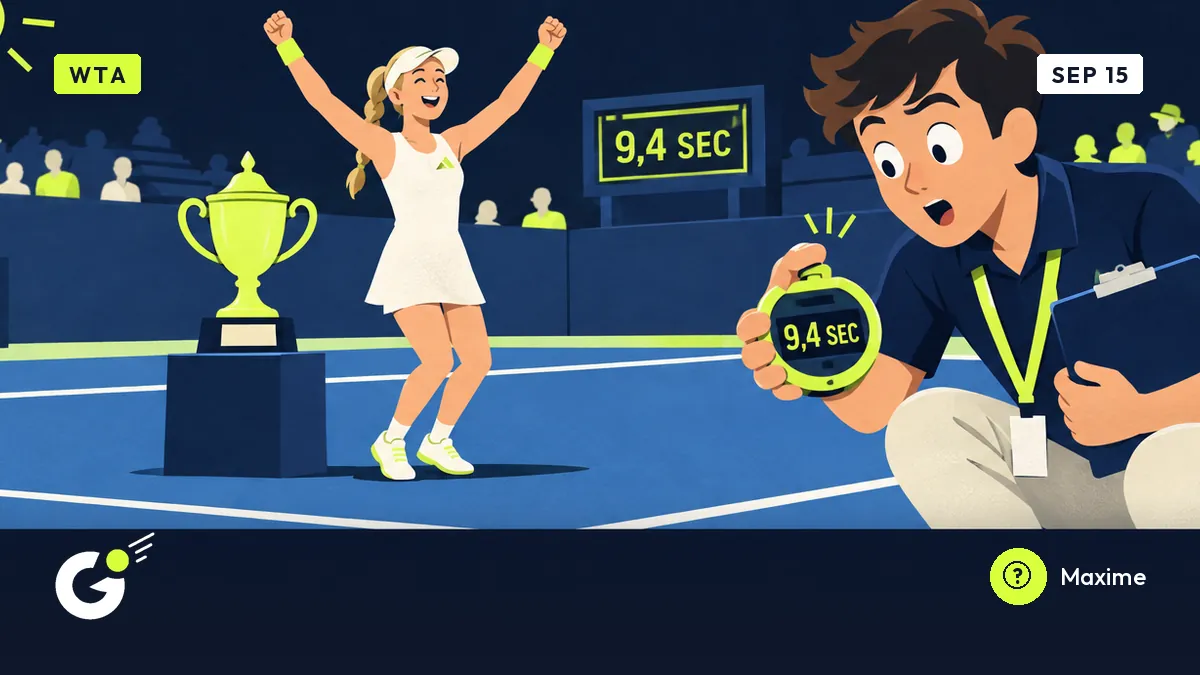
Elena Rybakina won the US Open on Saturday, 6-4, 5-7, 6-2 against Aryna Sabalenka. The last point was an ace. Then: arms up, three small knee bends, done. I watched it twice, convinced I had missed a bit.
Under ten seconds. For a first US Open title and a third Grand Slam.
Silly question, but is there a set length for this? I asked around. People told me “it depends on the player”, which is a polite way of saying nobody knows. I looked for a text, a scale, a line somewhere: nothing. Nobody puts a stopwatch on joy. So I did.
And there is a precedent, which doesn’t help. Rybakina became world number one in the rankings published on the Monday before the final, after her quarter-final win over Zheng Qinwen. L’Équipe wrote that she had “barely raised an eyebrow”. So: becoming the best player in the world, one eyebrow. Winning the US Open, three knee bends. I’m trying to build the scale and I get stuck halfway.
I did the maths: three knee bends for a Grand Slam, that’s one bend per major title. If she wins a fourth, we’re on four bends, and there we go past ten seconds. I checked, and actually nobody knows what happens at that point. Anyway, I still have a lot to learn.
An older colleague said something to me that I’m writing down here word for word.
Three knee bends. In 1980, you dropped to your knees, and you stayed there as long as it took. I’m not criticising. I’m comparing.
L’Équipe describes her game as “piercing yet fluid” and calls her the new boss of the tour. That, at least, you can measure on the scoreboard: 6-4, 5-7, 6-2.
It’s true, we checked: L'Équipe.