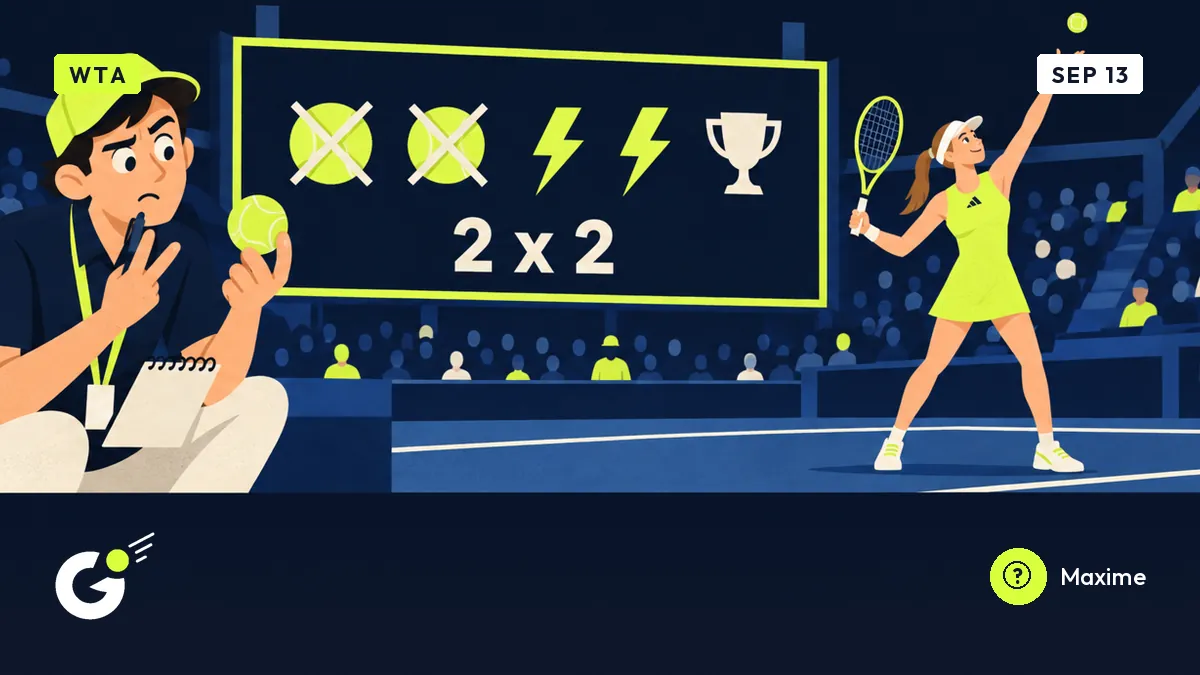
One service game. Two double faults, two aces, and a Grand Slam title at the end of it. That was the last game of the US Open final on Saturday, Elena Rybakina against Aryna Sabalenka, 6-4, 5-7, 6-2.
Silly question, but: why do you get two attempts on the serve, and only one everywhere else on the court? I asked around. I’m told it’s tradition, fine, but what does that mean? I checked, and actually nobody can tell me when somebody decided this.
What interests me is what it produces. In the first set, Rybakina landed only about a quarter of her first serves. A quarter. She won 68% of the points behind her second, and she won the set. So the shot she missed three times out of four didn’t stop her taking the set. I read it twice.
If I misplace three quarters of my passes in football, I’m off at half-time. Here you miss three quarters of your first serves, you win the set, and by the end of the evening you’re world number one. I still have a lot to learn.
Rybakina explained herself what was going on in her arm: « On the first serve I actually wasn’t going that big, but then on the second, maybe I was just stopping the arm. I think it was coming pure out of emotions. » And on how she handled it during the match: « I was thinking about this, and that I need to really improve the first-serve percentage. It was not going. […] But then I was still trying to pick a spot and at least go a little bit more with the second serve. Few double faults here and there, but I kind of had a plan in my head, and I was just sticking to it. »
So the plan was to keep serving. Noted.
I’m told a double fault is the only point in tennis where the opponent did nothing at all. And that two of them in the title game is only human. I’d love people to be that understanding when I get an email wrong.
It is Rybakina’s third Grand Slam title. She played her first tournament at Flushing Meadows ten years ago, in the juniors.
It’s true, we checked: Tennis Majors.